
How NBA Seeding Works: A Simple Guide to the Playoff Race
How NBA Seeding Works: A Simple Guide to the Playoff Race
If you are new to the NBA, the word seeding just means where a team ranks in its conference heading into the postseason. The league does not seed all 30 teams together. Instead, teams are ranked separately in the Eastern Conference and the Western Conference based on their regular season results.
A team’s seed matters because it decides three huge things: whether that team gets into the playoffs automatically, whether it has to survive the Play-In Tournament, and who it will face in the first round. That is why standings become such a big deal near the end of the season.
The basic idea
At the end of the regular season, each conference is ordered by record. The No. 1 seed is the team with the best record in that conference. The No. 2 seed has the second-best record, and that continues down the standings. Since the NBA changed its format in 2015, playoff teams in each conference are seeded by regular-season record rather than automatically giving division winners a top-four seed.
That means if a team wins its division but does not have one of the top records in the conference, it does not automatically jump higher in the bracket. Divisions still matter, but mostly in tie situations rather than as an automatic seeding shortcut.
Which seeds make the playoffs?
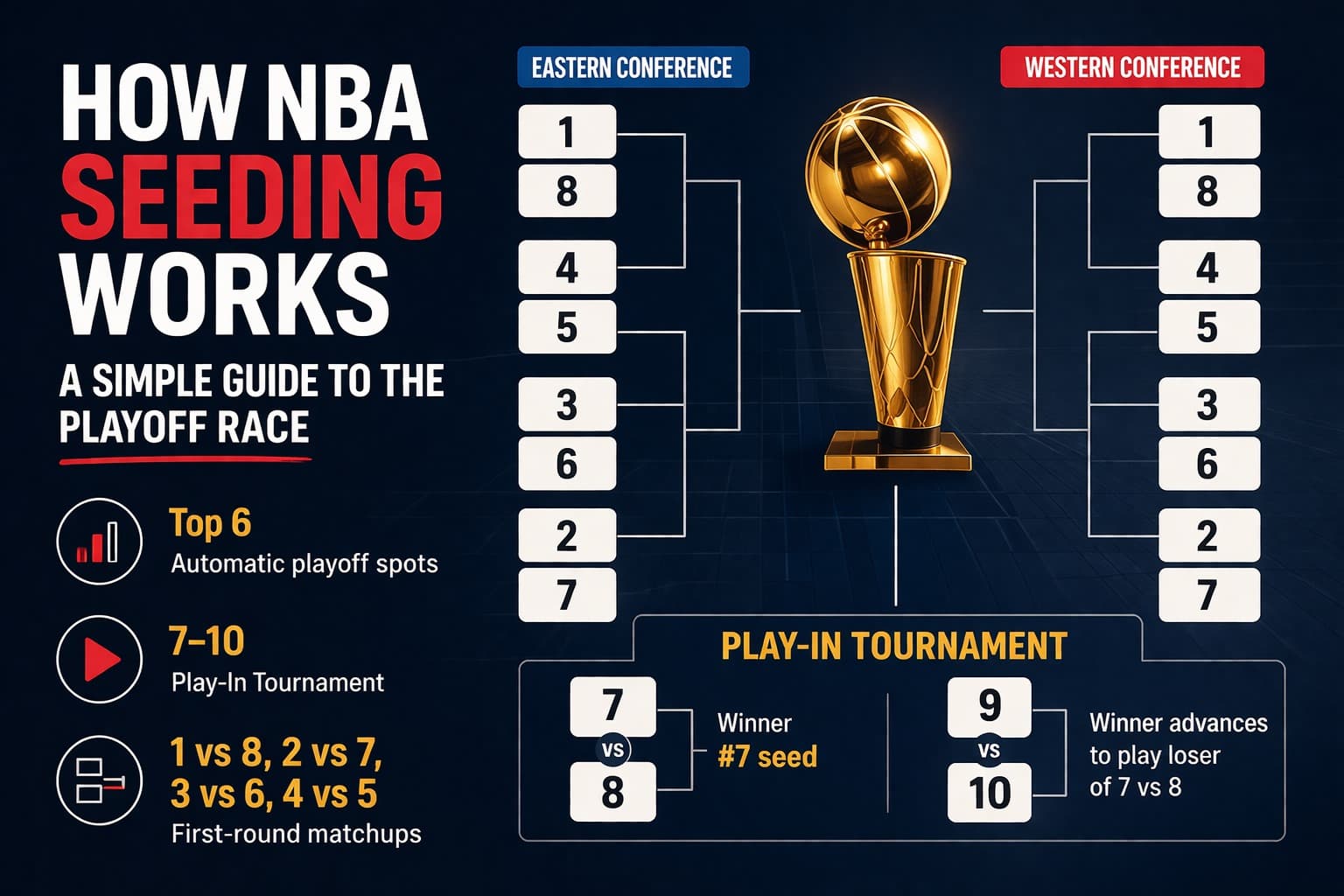
The top six teams in each conference qualify for the playoffs automatically. Teams that finish 7th through 10th do not lock in a playoff series right away. Instead, they go into the Play-In Tournament to fight for the final two playoff spots in their conference.
So in simple terms:
Seeds 1 to 6 are safely in Seeds 7 to 10 go to the Play-In Seeds 11 to 15 miss the postseason entirely How the Play-In Tournament works
The Play-In is built to reward the teams that finished higher in the standings. The 7 seed hosts the 8 seed, and the winner grabs the No. 7 playoff seed. The loser is not out yet.
Then the 9 seed hosts the 10 seed. The winner stays alive, while the loser is eliminated immediately. After that, the loser of the 7 vs. 8 game hosts the winner of the 9 vs. 10 game. The winner of that final matchup becomes the No. 8 seed.
That setup creates a real advantage for finishing 7th or 8th instead of 9th or 10th. A 7th or 8th place team gets two chances to earn a playoff spot, while a 9th or 10th place team has no room for error.
What the first-round bracket looks like
Once the Play-In ends, the full playoff bracket is set. In each conference, the first round follows a standard format:
1 vs. 8 2 vs. 7 3 vs. 6 4 vs. 5
So if a team earns the No. 1 seed, it will face the No. 8 seed in Round 1. If a team lands at No. 4, it gets matched with No. 5. That is why even moving up just one spot in the standings can completely change a team’s path through the bracket.
What happens if two teams have the same record?
This is where tiebreakers come in. If two teams finish with the same record, the NBA uses an official order of rules to decide who gets the higher seed. For a two-team tie, the league starts with head-to-head record, then checks whether one team is a division leader, then looks at division record if the teams are in the same division, then conference record, then results against playoff-eligible teams, then point differential, and if needed, a random drawing.
Multi-team ties use a similar structure, but the sequence is slightly different because the NBA has to separate more than two teams at once. The important point is that seeding is not just about wins and losses. Head-to-head matchups, conference performance, and other details can decide who gets the better seed when records are identical.
Why seeding matters so much
Seeding is not just a number next to a team’s name. It shapes the entire postseason path. A higher seed means a cleaner route into the playoffs, a better first-round matchup on paper, and a lower chance of having to survive the Play-In. Even small swings in the standings can turn a direct playoff berth into a Play-In spot, or change an opponent from a beatable team to a title contender.
That is why the final weeks of the NBA regular season are always packed with scoreboard watching. Teams are not just trying to qualify. They are trying to land in the exact seed that gives them the best chance to make a deep run.
Final takeaway
The easiest way to think about NBA seeding is this: teams are ranked within their conference by regular-season performance, the top six get into the playoffs automatically, seeds 7 through 10 battle in the Play-In, and the final bracket lines up as 1 vs. 8, 2 vs. 7, 3 vs. 6, and 4 vs. 5. Ties are broken by a detailed NBA tiebreaker system when records are the same.
Once you understand that, following the playoff race becomes way easier and way more fun. Every late-season game suddenly has real meaning, because one win can change an entire postseason path

Ready to put it on the board?
Join a free tournament, make your picks and climb the standings. No real-money wagering — just skill.